Watch and listen to the interview with Tony Wheeler, co-founder of the Lonely Planet travel guide books. Choose the best option that finishes each statement.
Showing posts with label ELT. Show all posts
Showing posts with label ELT. Show all posts
Monday, November 5, 2018
Improve your skills: Listening
Watch and listen to the interview with Tony Wheeler, co-founder of the Lonely Planet travel guide books. Choose the best option that finishes each statement.

Monday, June 4, 2018
10 Most Common Mistakes Spanish People Make in English
We are all agree that making mistakes is part of the learning process. The Spanish people is aware of some of the mistakes they make when speaking or writing in english, and no matter wich drills are used in class to correct those mistakes, students seem to repeat them again and again.
Despite of the fact that most of them learn English since many years ago, some mistakes seem to be rooted in their linguistic repertoire and I would say they feel /comforteibol/ making them. Thus, we can to argue that the solution to this problem does not depend only of the teacher but there are other factors involved such as L1 interference (negative transfer).
The factor of negative transfer makes us to think that certain mistakes are more likely to occur on speakers who share the same L1. Let's have a more closer look at the 10 most common mistakes Spanish people make.
Connectors
All teachers must have seen their students saying or writing despite of. This is due to a negative transfer since in Spanish we say a pesar de, and the preposition of is explicit. This also causes hypercorrection with the connector in spite of as most students tend to drop the preposition of.
Verb patterns
Spanish students are taught in early stages of their learning process that the verb like is followed by a noun or another verb in -ing. When presented with another structure with like such as would like, some students tend to overgeneralize and use a verb in -ing as well. On the contrary we can see an example of hypercorrection when students use an infinitive after look forward to instead of -ing.
Articles
Using the definite article when talking in general is probably another example of negative transfer as the definitive article is widely used in Spanish, even in situations in which we would not use an article in English.
Modal verbs
A common mistake is also using infinitive with to after modal verbs such as can or must. This may be due to overgeneralization since students feel that there should be to before an infinitive as with most verbs.
 |
| Infographic made with www.easel.ly |
Subject-verb agreement
People is is a very frequent mistake among Spanish speakers. In Spanish the word people is often translated as gente which is followed by a singular verb.
Comparatives
Another example of overgeneralization is using a double comparative with a short adjectives (more faster). This is quite frequent in early stages but it is then corrected.
-ed/-ing adjectives
Confusing -ed and -ing adjectives is also very common. Spanish students tend to simplify and use -ed adjectives for everything and say things like the film is bored.
Now let's have a look at the top three mistakes. The ones that probably annoy teachers the most, or at least me:
Vocabulary
Using the verb to be before agree is something teachers are used to correcting at different stages. This is due to negative transfer as it is traslated in Spanish as estar de acuerdo with the verb to be explicit in the structure.
Pronunciation
Certain words ending in -able such as comfortable and vegetables are pronounced by Spanish people like table. This is due to a wrong hypothesis that makes them think all words ending in -able are pronounced that way.
Tenses
And finally it is time for my favourite: using the present simple with since and ago. This structure is very common in Spanish (Vivo en España desde hace 5 años) and students copy the structure in English word by word. Usually the also mispronounce the word since saying something like /sains/.
We can see students making these mistakes at different levels so we can assume they are also examples of fossilization.
There are also some other recurrent mistakes that didn't make this top 10 list but that could be included as well:
- Using the preposition of after the verb depend as they would say in Spanish.
- Dropping the first -h- from the relative pronoun which (wich). Obviously this is only found in writing.
- Saying for to + infinitive or for + -ing when using the infinitive of purpose: I went to the park for to see my friends.
- Using the verb have when talking about their age: I have 34 years old.
- Using the verb lose (sometimes loose) when miss should be used: I'm late because I lost the bus.
- Saying use to + infinitive to talk about present habits. This mistake usually happens after explaining used to + infinitive to talk about habits in the past.
If there are any other mistakes you think are worth mentioning or should be on the list please add you comments below.
Tuesday, June 6, 2017
Improve your skills: Writing
In the second paragraph state the advantages. Mention a couple at least and provide examples that support your arguments.
In the third paragraph state the disadvantages. Again mention at least a couple and provide examples as well.
In the final paragraph state your conclusion giving your own personal opinion about the topic.
Below you've got a sample of what a discursive composition might look like and what the position of connectors would be. You can write a for and against composition using this model on any of the following topics:
- Men watch too much sport.
- People don't care enough about the environment.
- Fast food is very bad for your health.
- Men are better at sports than wome.
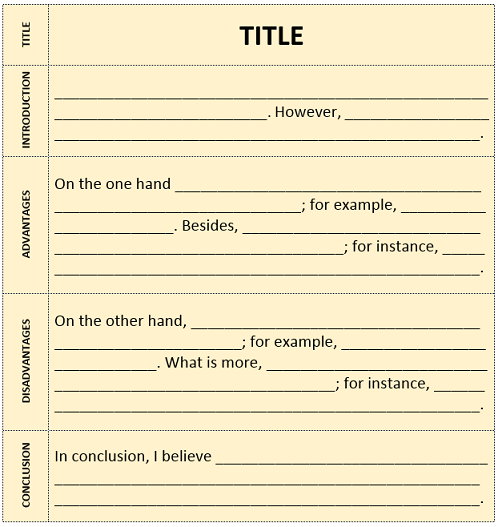
Some of the aspects that are taken into consideration when evaluating your piece of writing are the following:
Organisation: is the organisation of your piece of writing clear for the reader? Bear in mind the number of paragraphs and the information in each paragraph.
Style: have you used in your text a level of formality in accordance to the type of writing? Bear in mind the use of contractions, vocabulary, connectors…
Accuracy: have you used grammar and vocabulary appropriately and correctly? It is very important that verb tenses are introduced properly and the vocabulary is carefully selected.
Cohesion: have connectors been introduced correctly in order to link sentences and paragraphs so that the text has coherence?
Quality: depending on the level, the student is required to introduce certain grammar structures and vocabulary which are part of the syllabus for that particular level.
Wednesday, February 1, 2017
CONTINUING PROFESSIONAL DEVELOPMENT ON A BUDGET
Continuing Professional Development (CPD) is mandatory for teachers in order to stay up-to-date with current trends and innovations in your profession. Not everyone is able to enrol in development courses or start an MA due to time limitatons but also to money issues, but thanks to the Internet it is now possible to improve the quality of your work without spending too much (money and time). There are a lot of actions we can take to improve our CPD and I will comment on the ones I have found particularly useful recently.
Thursday, October 29, 2015
KEEPING A CLASSROOM BLOG
 |
| cdistudentscorner.blogspot.com |
This is a project that I've had in mind since last year and finally it has seen the light of day. I have started a classroom blog with my students. Why? well, first of all because it helps me keep a record of everything we do in class, I make myself post after every lesson with what we've done that day.
Secondly, thanks to google calendars I can keep all the students informed about the homework in the event they haven't come to class that day. It's much easier than sending out emails to all of them and, of course, they have no excuse for not doing it.
Thirdly, I can share with them any activities I've prepared myself for extra practice of reading, listening and writing. Embedding listening activities or grammar and vocabulary quizzes allows them to practise at home and get immediate feedback.
And finally, and most importantly, this is a place where students can share their written work with their peers. Sometimes we pay more attention to what our classmates are doing, just out of interest, than to the teachers explanations. Therefore, all students are contributors as well and they help to create content for the blog.
Anyone who wants to check it out please visit cdistudentscorner.blogspot.com
Tuesday, May 26, 2015
OPEN LETTER TO MY #YOUNGERTEACHERSELF
Dear 24-year-old Miguel
I’m sending you this letter encouraged by the
kind words of Ms. Joanna Malefaki, a great EFL teacher/blogger and better
person. She has started a blog challenge addressing teachers to write a letter
with advice to our younger self, and that’s the reason the hashtag for this
blog challenge is #youngerteacherself.
Monday, February 2, 2015
AN INFOGRAPHIC IS WORTH A 1000 WORDS
I have recently discovered how infographics have become a very useful tool in education and how learners seem to like them a lot. The old saying "An image is worth a thousand words", which was first coined more than one hundred years ago, is still valid today and can be used in the English classroom.
Monday, November 3, 2014
IMPROVING STUDENTS' READING SKILLS WITH FLIPBOARD
I've recently read an article talking about how new technologies and social networks could be introduced in the classroom to improve teacher-student interaction and motivate them with apps they are familiar with.
Monday, May 5, 2014
TEACHING GRAMMAR IN CONTEXT
Grammar, along with vocabulary, is the main tool that allows us to understand and produce a text thus allowing us to communicate effectively. Teaching grammar in class is sometimes seen as boring both on the part of the students, who perceive it as a monotonous activity, and the teachers, who struggle to provide a dynamic lesson that engages students.
Monday, February 3, 2014
USING POSITIVE LANGUAGE - HOMES
This is an activity I really like to use with
my students, it is suitable for B1-B2 students. They'll be able to practise
three of the four skills, reading, speaking and writing, while they learn new
vocabulary.
Wednesday, October 2, 2013
QUESTION TAGS: LISTENING + SPEAKING
Whenever I had to teach question tags I always found it a little bit boring for the students, and they never understood the purpose of using them. They were quite happy saying: "Your father is a pilot, no?" You English teachers should be familiar with this, shouldn't you?
Wednesday, May 1, 2013
IKEA ACTIVITY: SPEAKING + WRITING
This is an activity I created for my B1 students in order to practise the use of comparatives and superlatives with vocabulary related to the house.
Subscribe to:
Posts (Atom)